Procol HarumBeyond |
|
|
PH on stage | PH on record | PH in print | BtP features | What's new | Interact with BtP | For sale | Site search | Home |
|
Franc Gavin in Performance, 13 May 1977
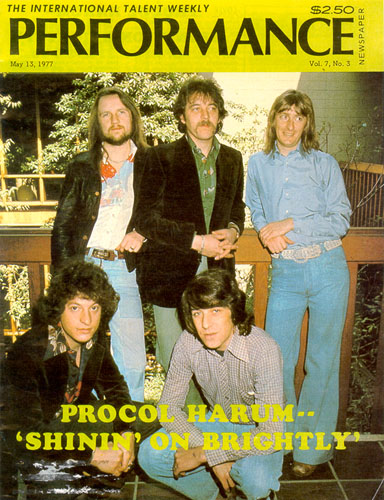
Here's an interesting review (we've tidied up some printing errors the copy-editor should have spotted) of one of the very last Procol gigs of the Old Testament; it doesn't mention bassist Dee Murray, but the magazine cover has a rare picture of the Murray line-up. Ironically, for an article dwelling on the band's longevity, it came out in the month they ceased trading. When you've devoured this, do read the author's commentary on it: he reveals the state of the music trade papers of the time, reflects on the death of the 60s ethos and the rise of punk, and perhaps most intriguingly of all tells how Procol were really feeling on the night of this concert, and what he actually thought of the show he reviews below!
Los Angeles: it's comforting to know that bands of Procol Harum's stature like to occasionally play medium-sized venues. In April that elusive ensemble chose to pull off a one-nighter at the 1000-seat Crescendo in Anaheim. Anaheim? You ask. Yes, and a mere mile from that fiberglass fantasyland that put this one-time community of orange-growers on the map.
Procol Harum put on an entertaining evening of larfin' and singin' characterized by a pleasantly aloof air personified in the enigmatic smile of Gary Brooker as he sang a lung-busting rendition of Salty Dog.
"Just a failed seaman, I am ..." he explained later. "I was born in London, but grew up in Southampton [should be Southend], near the sea. Needless to say, it gets in your blood finally got a bit out vicariously when we recorded A Salty Dog. That's one of the reasons I've enjoyed working in the context of this group for lo, these ten years I get to work out a lot of my fantasies. Haven't run dry yet."
Apparently not. The band's penchant for the clever hook is legend, and their treatment of Conquistador never fails to hit home. Brooker, along with the incessant assistance from drummer BJ Wilson made early, powerful headway with the SRO audience in Orange County's plushest new nightspot. Strangers, a tune from their new LP, showcased such a venerable institution as they remain venerable without becoming stale. A spacey, fluid number, utilising a lot of echo-slide and synthesizer harmonics, the stillness of mood created by its poignant instrumentation held close conjunction, once again, with Brooker's piano and vocals to create an atmosphere that captivated the audience.
Let's face it. Brooker's voice and piano, BJ Wilson's drums and Keith Reid's lyrics are the very soul of the band. Throughout the years many have come and gone from Procol Harum, while these three have remained to create the core of a sound that is intelligent, wry and expert yet sacrifices none of the spontaneity of honest-to-goodness Rock 'n Roll.
"It's easy to get in a rut," Brooker explained. "It's just as easy to get out of one that's one of the ways we've managed to keep our status for a decade we keep close check on ourselves and we don't record unless we feel very good about the whole thing. Sometimes we'll look back on this or that piece and reflect: 'now that that was a mistake; but we work hard for perfection. We can't allow too many bad moves. There just isn't enough room.'
Guitarist Mick Grabham has become well-situated in the cockpit of the instrumentation; his fret-work is lean, spare and fiery enough to nearly make one forget it was Robin Trower and not he who played on the recorded version of Simple Sister. His leads range from unabashed, as in Wizard Man, the group's new single, to the lyrical punctuation of the stratospheric Homburg, a procol-prototype which is perfectly exemplary of lyricist Keith Reid's way with the eccentric word.
"I get a lot of ideas for my lyrics on the road," Reid suggested, "and I always travel with the band when they're touring."
Alternating between the dance and the book of revelations, Procol graced the laser-lit stage with a show that was a catalogue of past and present, pleasing their audience as much as they pleased themselves with the performance.
Perhaps it's that unmistakable sound that is the secret of their longevity. 'That' sound, a raucous hybrid of Bach, English music hall and classic R&B moves, intrigues and amuses then attacks with a marvellously warped sense of humor. Brooker's grand piano and vocals put him on a par with such as Stevie Winwood, another who has made admirable uses of the possibilities of rhythm and blues inflections within an ambitious keyboard medium.
Procol Harum craft their presence with the diversionary tactics of the expert. Their music is an intelligent admixture of suspense, drama, pathos, comedy and just a touch of the lurid thrown in for spiciness' sake. As if an underline for the entire evening, Brooker thanked the crowd and led the band into an anthem-like Whiter Shade of Pale, the band's undisputable trademark.
It was easy to see, then, as Wilson's drumsticks literally conducted the familiar piece, that this was far from being sentimental indulgence; Procol Harum was merely re-iterating their position as a rock-solid institution.
|
PH on stage | PH on record | PH in print | BtP features | What's new | Interact with BtP | For sale | Site search | Home |
The truth is I was racking my brain to say something nice because with a trade like Performance that was all you were allowed to say I did tell Reid that the lyrics to Still There'll Be More were a vade mecum for us when we were in high school. He laughed and said that we "... must have been very naughty boys."
It might have been nice to use some of those words but, like I said, trade publications weren't given to that and now consumer books, what few there are these days, aren't even given to that. Which may be why there are fewer trades. Who needs them when it's all about advertising in any case? In truth Procol's two sets that night were quite lackluster. Nice picture though. We took that inside the courtyard of Warner Bros. records. And there was nothing ironic about them breaking up right after that Reid and Brooker both told me that they were going their separate ways. But the magazine decided against that going into the article.
Brooker was in a pretty pissy mood and Reid was drunker than shit and the rest of the band were stoned out of their minds. They were in fact all quite bored. Bored with that tour, bored with the venues, bored with the late-70s overblown production of the material on Something Magic, and bored with life. The overall impression was they just wanted to get through and get out. A sentiment, albeit perceived, which I heartily shared by the end of the evening.
The music business in late 70s had reached an almost absolute and unwitting zero, and as usual in all of their dead certainty that they had at last found the perfect and endlessly lucrative formula, they were not prepared for the financial dropout that coincided with the sudden decline in sales of almost all of their major acts. Market saturation of arena rock acts, the signing of acts that sounded just like existing arena rock acts, and the almost absolute control that major labels exerted over the distribution of music, both in stores and on radio, had resulted in three things complete fiscal irresponsibility and utter boredom (see above). And disco. By 1979 the bulk of most new releases, mainstream and otherwise, dιbuted in the promo bins of record stores. Someone said that the state of bands like PH at the Something Magic point was the reason punk had to happen. I think that the state of bands like PH and others at this time was an index of why just plain mud-bad albums like Something Magic saw the light of day. Bands like Procol, Family et al were being compressed to two dimensions under the crushing weight of a business that wanted to continually tweak the elements of the 60s into a seamless, virtually featureless and in their minds commercially irresistible product. Punk, looming just beyond the periphery, was the blow out. Where all the compression finally exceeded the capacity of the container.
Regarding trade publications and music journalism in general from that period. There were three major music trade publications from that period Billboard, Cashbox and Record World. All three looked remarkably similar: large format saddle-stitched weeklies with enough room on their huge pages for double-truck vanity ads guaranteed to satisfy the most monstrous of egos. Most of the content was in fact edited or only slightly rewritten press releases. The rest consisted of industry profiles, the odd but always positive review, lists of current releases and best sellers. In other words much like Billboard (the only remaining of the three) still is today. Bracketing those stood Variety, at the high end, and the Hollywood Reporter, at the low end. But neither of those exclusively reported on the music industry music in fact took a back seat in both publications to the movie business. There were of course a few major consumer rags like Rolling Stone, Creem, and Crawdaddy! plus numerous smaller operations, free weekly giveaways and other minor trades like Performance whose niche was in the booking and management market. Its pages were devoted primarily to tour listings, booking agencies and venues.
Up until that time the Los Angeles basin was rife with music journalists. It had been (with some diligence) possible to make a modest living as a freelance writer. Unless of course somebody in publicity, marketing or A&R took notice of you which of course was most peopleΉs dream, ie to sell out. Of course to sell out there has to be somebody who is interested in buying and at that time nobody in the record industry was building an empire. They were desperately trying to hang on to what they had. Basically anybody with a maverick reputation had it tough from that point on this is when any semblance of critical thinking in this business, nascent as it, was really started its long slow death. Those inside the industry either got in line or got the axe the writers either went to work for dailies, got into trades for a while, doomed as well, since as I said earlier who needed more than one or moved on.
Don't get me wrong: the industry was, as the industry will always be, full of hacks. And surrounded by them as well. To enjoy longevity in that business is to produce, consciously or unknowingly, the hackneyed. But there was a contingency of perhaps less than ten per cent who were interested in the shock of the new, who kept trying to promote critical thinking. Not that they could always afford to exercise those muscles and maintain that modest income through their writing. But there were, at that time, always a few opportunities. Publicists hated them with a passion: even when their pieces were of a positive nature, they were still difficult to quote. Sometime between 197782 this went away. Not unexpected in a business where everyone is in a dead-heat race to be second. And after the 70s the record industry to this day has never got over its need to turn everything it encounters back into that entropic surface smooth, polished and utterly dead. In its ever-vigilant attempts to avoid anything that it perceives as its possible demise, it always, always heads straight for it.
And at last, nearly thirty years after that last Procol gig in Anaheim, it appears to be achieving that long desire.